Click any AI tool above to instantly get a summary of this article. Perfect for quick insights when you're short on time.
When you purchase clothing, electronics, furniture, or household supplies in most parts of the United States, the amount you pay at checkout is higher than the advertised price. The difference is usually caused by state and local sales taxes.
However, shoppers in a small number of states can buy many everyday products without paying a general statewide sales tax. This raises an important question: why do some states have no sales tax?
States without a general sales tax have not eliminated taxation altogether. Instead, they use different combinations of income taxes, property taxes, corporate taxes, natural-resource revenue, business taxes, tourism taxes, and government fees to pay for public services.
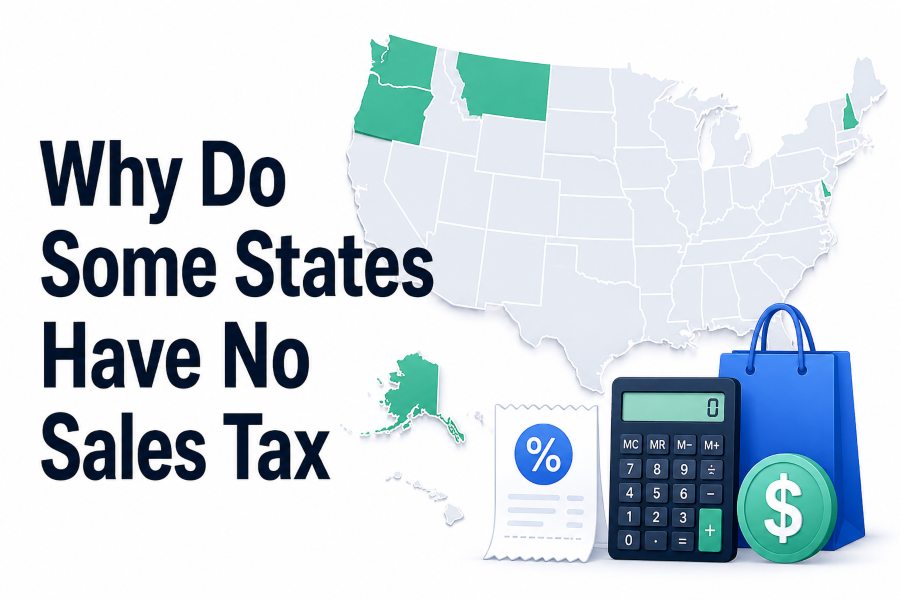
As of 2026, the five states without a general statewide sales tax are:
- Alaska
- Delaware
- Montana
- New Hampshire
- Oregon
Alaska is a special case because some cities and boroughs impose local sales taxes even though the state government does not. Delaware, Montana, New Hampshire, and Oregon do not impose a broad state sales tax on ordinary retail purchases.
This article explains why these states have chosen a different tax structure, where they obtain government revenue, and whether living in a state without sales tax actually saves residents money.
What Is a Sales Tax?
A sales tax is a consumption tax charged when a customer purchases taxable goods or services. The retailer collects the tax from the customer and sends it to the appropriate state or local government.
For example, suppose an item costs $1,000 and the combined sales tax rate is 7%. The calculation would be:
- Advertised price: $1,000
- Sales tax: $70
- Final purchase price: $1,070
The business does not usually keep the additional $70. It collects the money on behalf of the government and remits it according to state and local filing requirements.
Sales-tax rules differ significantly between jurisdictions. A state may tax clothing and electronics while exempting groceries, prescription medications, or certain services. Cities and counties may also add local taxes on top of the statewide rate.
Sales-tax revenue is commonly used to support:
- Public schools
- Roads and transportation
- Police and fire departments
- Healthcare programmes
- Local government operations
- Parks and public facilities
- Emergency services
Because consumer spending occurs throughout the year, sales taxes can provide governments with a recurring source of revenue.
Why Do Some States Have No Sales Tax?
States are not required to use identical tax systems. Each state decides how it will raise enough money to fund its government and public services.
Some states depend heavily on sales taxes. Others place more emphasis on income, property, business, tourism, or natural-resource taxes.
The states without a general sales tax have determined that they can generate revenue through other sources. Their decisions are also influenced by political traditions, voter preferences, local economic conditions, and historical tax policies.
Here are the primary reasons why some states do not have sales tax.
1. They Use Other Sources of Tax Revenue
The simplest explanation is that states without sales tax collect money in other ways.
Eliminating a general sales tax does not eliminate the cost of running a state. Governments must still pay for education, transportation, public safety, courts, administration, and other essential programmes.
Alternative sources of revenue may include:
- Individual income taxes
- Corporate income taxes
- Property taxes
- Business gross-receipts taxes
- Natural-resource taxes
- Hotel and lodging taxes
- Restaurant taxes
- Fuel and tobacco taxes
- Real-estate transfer taxes
- Government licences and fees
Oregon, for example, does not have a general sales or transaction tax, but it does collect personal income tax. Oregon employers generally withhold state personal income tax from employee wages.
The important point is that a state must balance its tax structure. When one major tax is absent, other taxes or revenue sources usually become more important.
2. No Sales Tax Can Encourage Shopping
A state without sales tax may become more attractive to consumers, particularly when it is located near states with comparatively high sales-tax rates.
Consumers may cross state borders to purchase:
- Computers
- Televisions
- Appliances
- Furniture
- Clothing
- Jewellery
- Business equipment
The potential savings become more noticeable as the price of the purchase increases. Avoiding a 6% sales tax on a $50 product saves only $3, but avoiding the same rate on a $3,000 purchase saves $180.
Retail businesses may benefit from this additional consumer traffic. Shoppers who travel for a major purchase might also spend money at local restaurants, petrol stations, hotels, and other businesses.
Delaware is particularly well known for tax-free retail shopping. The state does not impose state or local sales taxes on consumers, although businesses may be responsible for gross-receipts taxes.
3. Residents May Prefer a Different Type of Tax
Tax policy is also influenced by public opinion.
Some voters oppose sales taxes because they raise the cost of ordinary purchases. Once residents become accustomed to shopping without a general sales tax, proposals to introduce one can face strong political resistance.
People may prefer income taxes because those taxes are based more directly on earnings. Others may prefer sales taxes because they are paid gradually as money is spent.
There is no universally perfect tax system. Every structure distributes the burden differently among:
- Residents
- Property owners
- Consumers
- Tourists
- Employees
- Retirees
- Businesses
- High-income households
- Low-income households
The tax system a state adopts often reflects its political history and the types of taxes its voters are willing to accept.
4. Sales Taxes Can Be Regressive
Sales taxes are often described as regressive because lower-income households tend to spend a larger portion of their available income on everyday necessities.
Two consumers may pay the same sales-tax rate on a washing machine, but the tax can represent a much larger share of the lower-income consumer’s monthly budget.
A state can reduce this effect by exempting necessities such as groceries and medicine. Another option is to avoid a general sales tax and rely more heavily on income-based taxes.
However, removing sales tax does not guarantee that the entire state tax system is progressive. High property taxes, business taxes, or fees may still create financial pressure for particular groups.
5. Certain States Have Unique Economic Advantages
Some states have access to revenue sources that are not equally available elsewhere.
Alaska is the most obvious example. Its economy and public finances have historically been influenced by oil, gas, and other natural resources. Alaska does not impose a statewide sales tax or personal state income tax, although local governments may levy property and sales taxes.
Delaware has built a business-friendly legal and corporate environment. Although shoppers do not pay sales tax, businesses may pay gross-receipts, corporate income, franchise, and licensing taxes. Delaware’s gross-receipts tax is imposed on sellers rather than directly on consumers at checkout.
These examples show that no-sales-tax states do not all follow the same financial model.
The Five States Without a General Statewide Sales Tax
Each no-sales-tax state has its own approach to raising revenue.
Alaska
Alaska does not impose a statewide general sales tax. However, several municipalities impose their own local sales taxes.
Local governments in Alaska have broad authority to decide what is taxable, subject to applicable state laws and voter approval. Therefore, a purchase that is tax-free in one part of Alaska may be taxable in another.
Alaska relies on a combination of revenue sources, including:
- Natural-resource revenue
- Oil and gas taxes
- Corporate taxes
- Federal funding
- Local property taxes
- Local sales taxes in participating municipalities
- Fees and other charges
For consumers, this means that “Alaska has no sales tax” is only partly accurate. It has no statewide sales tax, but local rates may still apply.
Delaware
Delaware does not impose a state or local general sales tax. Shoppers ordinarily pay the displayed retail price without an additional percentage being added as sales tax.
However, Delaware imposes gross-receipts taxes on many sellers of goods and providers of services. The tax is calculated using a business’s total receipts, and its rate depends on the type of business activity.
Although the gross-receipts tax is legally imposed on the business, companies may account for the expense when setting their prices. Therefore, consumers may indirectly bear part of the cost even when it does not appear as a separate charge on the receipt.
Delaware also receives money from corporate income taxes, franchise taxes, business licences, personal income taxes, and other sources.
Montana
Montana does not impose a broad statewide sales tax on ordinary retail purchases. However, it does collect taxes on selected activities and products.
For example, Montana imposes taxes on overnight lodging. Its lodging facility system includes a use tax and a sales tax that combine into a tax on qualifying accommodation charges.
Montana also relies on revenue from sources such as:
- Individual income taxes
- Corporate taxes
- Natural-resource taxes
- Property taxes
- Lodging taxes
- Fuel and tobacco taxes
- Government fees
Therefore, visitors may purchase ordinary retail products without general sales tax while still paying taxes on accommodation and other specified transactions.
New Hampshire
New Hampshire does not have a general sales and use tax on goods. This makes it a popular shopping location for consumers from nearby states.
However, New Hampshire imposes taxes on selected services and business activities. Its Meals and Rooms Tax applies to qualifying restaurant meals, hotel rooms, and motor-vehicle rentals. The state lists the rate as 8.5% for taxable periods beginning October 1, 2021.
New Hampshire also collects revenue through:
- Business profits tax
- Business enterprise tax
- Property taxes
- Real-estate transfer tax
- Tobacco tax
- Communications services tax
- Meals and rooms tax
- Other specialised taxes and fees
Although New Hampshire does not charge a broad tax on retail goods, residents may experience comparatively significant property-tax obligations depending on their municipality and property value.
Oregon
Oregon does not have a general sales tax or transaction tax. Most shoppers pay the advertised price for ordinary retail goods without a statewide sales-tax charge.
The state does, however, impose certain targeted taxes, including vehicle-related taxes in specified circumstances.
Oregon relies more heavily on other revenue sources, particularly personal income taxes. This creates a trade-off: residents avoid general sales tax when spending money but may pay more through income-based taxation.
Anyone comparing Oregon with another state should therefore evaluate both shopping costs and paycheck deductions rather than focusing only on sales tax.
How Do States Without Sales Tax Pay for Public Services?
Every state needs enough money to operate. The absence of sales tax simply changes how that money is collected.
Personal Income Taxes
Oregon, Montana, and Delaware collect personal income taxes. Income-tax revenue can support schools, healthcare services, transportation, and state administration.
Income tax is based on earnings rather than spending. Depending on the state, higher earners may pay a higher marginal rate than lower earners.
State income-tax rules are separate from federal taxes. Anyone confused by deductions from their paycheck can read our guide explaining why federal income tax is so high.
You can also compare different state systems by learning whether Tennessee has state income tax.
Property Taxes
Property taxes are especially important for local governments. They commonly fund:
- Public schools
- Police departments
- Fire protection
- Libraries
- Parks
- Roads
- Municipal services
A state with no sales tax may have areas with relatively high property taxes, although rates can differ greatly between counties and municipalities.
Homeowners should also understand that paying property tax does not automatically mean the entire amount will reduce their federal tax bill. Read how much of your property taxes are tax deductible for a detailed explanation.
Business Taxes
States can collect revenue directly from businesses through:
- Corporate income taxes
- Franchise taxes
- Gross-receipts taxes
- Payroll-related taxes
- Business licensing fees
- Industry-specific assessments
Delaware’s gross-receipts tax demonstrates how a state can tax commercial activity without placing a separate general sales-tax charge on the customer’s receipt.
Tourism and Hospitality Taxes
States without general sales tax may still tax activities associated with tourism.
Hotel rooms, restaurant meals, car rentals, alcohol, tobacco, and fuel may be taxable even when clothing and electronics are not.
This allows a state to collect money from visitors as well as residents. New Hampshire’s Meals and Rooms Tax and Montana’s lodging taxes are examples of targeted consumption taxes.
Natural-Resource Revenue
States with valuable natural resources may collect:
- Severance taxes
- Production taxes
- Royalties
- Lease payments
- Corporate taxes from resource companies
These revenue sources can reduce the need for broad consumer taxes. However, dependence on natural resources can create budget uncertainty when commodity prices or production levels decline.
Advantages of Having No Sales Tax
A no-sales-tax system can offer several benefits.
Lower Checkout Prices
The most visible advantage is the amount paid at the register. A product advertised for $500 generally costs $500 in a state without general sales tax, unless a specialised tax or fee applies.
This benefit is especially noticeable on high-value purchases.
Increased Retail Activity
Retailers near state borders may attract customers from neighbouring states. Increased traffic can support shopping centres, restaurants, petrol stations, and other local businesses.
Simpler Consumer Pricing
The price shown on the shelf is often closer to the final amount charged. This can make budgeting easier for consumers who are accustomed to sales tax being added only at checkout.
Reduced Tax on Everyday Consumption
Households that spend a large share of their income on taxable necessities may benefit when those purchases are not subject to a general sales tax.
Disadvantages of Having No Sales Tax
The absence of sales tax also creates trade-offs.
Higher Taxes Elsewhere
Residents may face higher income taxes, property taxes, business taxes, or fees. A state must still fund its programmes, so removing one tax does not remove the underlying cost of government.
Greater Dependence on Particular Revenue Sources
A state that depends heavily on income taxes may experience lower revenue during a recession when employment and earnings fall.
A state dependent on natural-resource revenue may face budget pressure when energy prices decline.
Visitors Contribute Less Through Retail Purchases
Sales taxes allow states to collect revenue from tourists and temporary visitors whenever they shop. Without a general sales tax, more of the burden may fall on residents unless the state taxes hotels, restaurants, rentals, or other tourism-related activities.
Businesses May Still Face Hidden Tax Costs
In Delaware, businesses can owe gross-receipts tax even though consumers do not see sales tax on their receipts. Companies may include these costs when determining product prices.
Therefore, a product is not necessarily cheaper simply because no tax appears as a separate line on the receipt.
Does No Sales Tax Mean a State Is Cheaper?
Not necessarily.
A state without sales tax may still have:
- High housing costs
- High property taxes
- State income tax
- Expensive insurance
- High utility bills
- Special local taxes
- Costly government fees
- Higher prices for goods and services
To compare two states accurately, consider the total financial picture:
- State income-tax liability
- Property-tax rates
- Local taxes
- Housing costs
- Sales and excise taxes
- Insurance expenses
- Transportation costs
- Employment opportunities
- Average wages
- Retirement-tax rules
A retiree, renter, homeowner, business owner, and high-income employee may reach different conclusions about the same state.
Someone who spends heavily but earns a modest income might benefit from a state with income tax but no sales tax. A high earner who spends relatively little might prefer a state with sales tax but no personal income tax.
Your personal circumstances matter more than the absence of a single tax.
Can You Avoid Sales Tax by Shopping in Another State?
Crossing a state border to shop does not always eliminate your tax obligation.
Depending on the type of purchase and the laws of your home state, you may owe use tax when you buy an item in a no-sales-tax state and bring it home.
Use tax generally complements sales tax. It is intended to prevent residents from avoiding tax simply by purchasing taxable goods elsewhere.
Rules may be especially important for:
- Vehicles
- Boats
- Business equipment
- Online purchases
- Expensive electronics
- Items delivered across state lines
For example, Oregon does not impose a general transaction tax but has specific vehicle-use and vehicle-privilege tax rules.
Before making a major out-of-state purchase, check the laws of both the purchase state and your home state.
How Sales Tax Can Affect Your Federal Tax Return
Federal taxpayers who itemise deductions may be able to choose between deducting eligible state and local income taxes or eligible state and local general sales taxes. They generally cannot deduct both categories for the same tax year.
The IRS explains that taxpayers electing the sales-tax deduction may use actual expenses or optional sales-tax tables. Federal deduction limits and eligibility rules can change, so taxpayers should review the current Schedule A instructions for the relevant year.
Living in a no-sales-tax state may make the state income-tax deduction more relevant, while residents of states without personal income tax may consider the sales-tax option.
Your final refund also depends on withholding, credits, income, deductions, filing status, and other factors. Learn more in our guide to why your tax return may be so low when you claim 0.
Frequently Asked Questions
Which states have no statewide sales tax?
Alaska, Delaware, Montana, New Hampshire, and Oregon do not impose a general statewide sales tax.
Does Alaska have sales tax?
Alaska does not have a statewide sales tax, but some cities and boroughs impose local sales taxes. The amount and taxable items depend on the municipality.
Is everything tax-free in Oregon?
No. Oregon has no general sales or transaction tax, but certain specialised taxes still apply, including taxes associated with some vehicle purchases.
Why does Delaware have no sales tax?
Delaware uses other revenue sources, including personal and corporate income taxes, franchise taxes, business licences, and gross-receipts taxes.
Does New Hampshire tax restaurant meals?
Yes. Although New Hampshire has no general sales tax on goods, its Meals and Rooms Tax applies to qualifying restaurant meals, hotel rooms, and motor-vehicle rentals.
Are states without sales tax always cheaper?
No. Residents may pay higher income taxes, property taxes, business taxes, housing costs, or government fees. Total cost of living is more important than one tax category.
Can I buy a car in a no-sales-tax state and avoid tax?
Not necessarily. Your home state may charge sales or use tax when you register the vehicle. Vehicle-tax rules should be checked before making an out-of-state purchase.
Final Thoughts
So, why do some states have no sales tax?
They have chosen to fund public services through different combinations of income taxes, property taxes, business taxes, natural-resource revenue, tourism taxes, excise taxes, and government fees.
Eliminating a general sales tax can lower checkout prices, encourage retail activity, and reduce the tax placed on everyday spending. However, it does not mean residents live tax-free or automatically have a lower overall cost of living.
Alaska, Delaware, Montana, New Hampshire, and Oregon each demonstrate a different approach. Alaska benefits from natural resources while allowing some local sales taxes. Delaware taxes many businesses through gross receipts. Montana and New Hampshire impose selected tourism and hospitality taxes. Oregon relies significantly on income-based revenue.
Before moving to or shopping in a no-sales-tax state, consider the complete tax structure. The best state for your finances depends on your income, spending, housing situation, property ownership, employment, and long-term financial plans.

Comments
0 responsesNo comments yet. Be the first to share your thoughts.